How to Protect Your Crypto Holdings From the Biggest Risks in 2026
You can order the same kind of articles for your own video to boost it on YouTube and Google. Just message the Telegram bot @sat_sit_bot. The bot writes and publishes the articles itself (with your YouTube video embedded) on popular topical websites (no ads). Your first 50 articles are free.
Key takeaways
- The warning targets holders who keep coins on exchanges and lending platforms rather than in self-custody.
- Regulation risk is framed as a structural issue for tokens that depend on a single jurisdiction or a single company.
- Major coins named by viewers as regulation-resistant include BTC, ETH, SOL, ADA, ZEC and NIGHT.
- A $500 deposit bonus is offered via Weex with the code oz5p, and a $10k bonus via Bitunix with no KYC.
- The counter-argument raised most often: the bigger risk is holding no crypto at all.
The core advice for crypto holders is to move the majority of your coins into self-custody, spread exposure across platforms and assets, and treat any yield offer as a risk premium rather than free money. The Altcoin Daily warning video makes the same point from a different angle: the danger is rarely the asset itself, it is where the asset sits and who controls it. If you want to test a platform with a small position first, you can unlock a $500 deposit bonus on Weex and keep the bulk of your holdings off-exchange.
What the crypto warning to holders actually says
The warning is not a price call; it is a custody and counterparty call. Holders are told that the biggest losses in crypto cycles come from coins being frozen, lent out, or locked behind a platform that stops withdrawals, not from a bad entry price on Bitcoin. The video pushes viewers to ask three questions about every position: who holds the private keys, what happens if that entity fails, and how quickly the position can be exited.
That framing matters because it shifts attention from chart-watching to operational hygiene. A holder who keeps 100% of a portfolio on one exchange is running a single point of failure regardless of which coins they own. The practical fix is boring: hardware wallet for the long-term stack, a small trading balance on an exchange, and no more than a testable amount in any yield product.
The second layer of the warning concerns regulation. Tokens that depend on one company, one license, or one jurisdiction carry an extra risk that has nothing to do with their technology. When a regulator moves, the token does not just fall in price; it can become unsellable on the venues that matter.
How to separate regulation-proof coins from the rest
The test is simple: ask whether the asset can keep functioning if its main exchange, its main issuer, or its main country of operation disappears tomorrow. Bitcoin passes most versions of that test because it has no issuer and no headquarters. Ethereum, Solana and Cardano pass it in a weaker form, since their value depends on networks of validators and developers rather than a single company.
Viewers repeatedly name BTC, ETH, SOL, ADA, ZEC and NIGHT as the coins they consider least dependent on regulators. The reasoning is not that these assets are immune; it is that none of them needs a permission slip from one authority to keep transferring value. Privacy-oriented coins such as ZEC sit at the opposite end of the regulatory spectrum, which is exactly why some holders treat them as a hedge and others treat them as a liability.
The coins that fail the test are the ones whose entire thesis is a single company's product, a single bank partnership, or a single license. Those are not automatically bad investments, but they should be sized as venture bets, not as core holdings.
The real risks holders should rank above price
Price volatility is the risk everyone talks about and the one that is easiest to survive. Ranked by damage, the order looks different:
- Custody failure — an exchange freezes withdrawals or goes insolvent. Recovery is slow and usually partial.
- Smart contract and yield risk — a lending protocol is exploited or a stablecoin depegs. The AAVE question viewers keep asking is really this one: holding the token and depositing into the protocol are two different risks.
- Regulatory action — a token is delisted or restricted in a major market, cutting off liquidity.
- Macro shocks — war and energy shortages hit every risk asset at once, and crypto is not a safe haven in those moments.
- Behavioral risk — panic selling at the bottom, or over-sizing a position that cannot be held through a drawdown.
Notice that price appears nowhere near the top. A 50% drawdown is survivable if the coins are still in your wallet; a frozen account is not survivable at any price.
Typical questions from crypto holders, answered
Should you avoid large retail brokers entirely? Not necessarily, but understand what you own. Buying crypto through a brokerage app usually means you hold an IOU, not the asset, and you cannot withdraw it to a wallet. That is acceptable for a small speculative position and unacceptable for a long-term stack. The same logic applies to any platform that offers a yield on your deposit: the yield is compensation for the risk that you may not get the deposit back.
Should you skip DeFi tokens like AAVE? Separate the two decisions. Holding the token is a bet on the protocol's growth; depositing funds into the protocol is a bet on its code and collateral. Many holders do the first and never do the second.
What about missing the cycle altogether? The most common counter-argument in the comments is that the biggest risk is owning no crypto at all. That is a legitimate view, and it is compatible with the warning: own crypto, just own it directly and size it so that a 70% drawdown does not force a sale.
Where to register and what the bonus offers include
Two promotional links are attached to the video, and both should be treated as onboarding offers rather than investment advice:
- Weex welcome event: https://www.weex.com/events/welcome-event?vipCode=oz5p&qrType=activity — a $500 deposit bonus tied to the referral code oz5p.
- Bitunix registration: https://www.bitunix.com/register?vipCode=AltcoinDaily — advertised as a $10k bonus with no KYC requirement.
A no-KYC offer is convenient and also means less recourse if something goes wrong, so keep only a test balance there. If a bonus requires a deposit or trading volume to unlock, read the conditions before funding; bonus funds are not the same as withdrawable capital.
Conclusion
The warning to crypto holders is straightforward: the assets are not the main problem, the custody and counterparty choices around them are. Keep the long-term stack in self-custody, spread trading balances across platforms, rank custody and contract risk above price volatility, and treat every yield and bonus as a risk premium. If you want to test a new venue with a small amount first, you can claim the $500 Weex deposit bonus and keep the rest of your portfolio where you alone control the keys. The video breakdown was published by Altcoin Daily, which has been covering these custody and regulation themes for years.
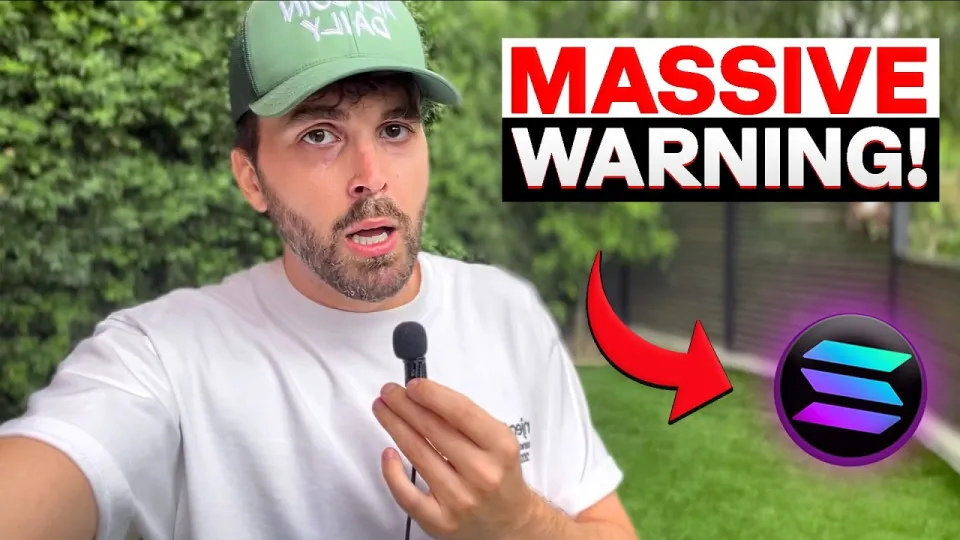
Source: My MASSIVE Warning To Crypto Holders · Markdown version
Questions & answers
Is it safer to hold crypto on an exchange or in a self-custody wallet?
Self-custody is safer for long-term holdings because no company can freeze your coins or lose them in an insolvency. Exchanges remain useful for active trading and for converting fiat, so most holders keep a small trading balance on a platform and the rest in a hardware wallet. The trade-off is that a lost seed phrase cannot be recovered by anyone.
Which coins are least exposed to regulation risk?
Bitcoin is the clearest case because it has no issuer or headquarters. Ethereum, Solana and Cardano depend on distributed networks rather than a single company, so they are less exposed than tokens tied to one firm or license. Privacy coins like ZEC sit at the other extreme and can face delistings, which is a risk in itself.
Do I need to avoid DeFi protocols such as AAVE?
No, but separate holding the token from depositing funds into the protocol. Owning AAVE is a bet on the protocol's adoption, while lending into it exposes you to smart contract exploits and collateral failures. Many holders take the first position and skip the second.
What is the biggest risk for crypto holders right now?
Custody and counterparty failure rank above price volatility, because a frozen account or an exploited contract can wipe out a position permanently. Macro shocks such as war and energy shortages hit the whole market at once, but they are survivable if your coins stay in your own wallet. Sizing positions so a deep drawdown never forces a sale is the simplest defense.